
The Truth About Monopoly's Short Line Railroad
Most people who play Monopoly know the four railroads on the board:
B&O Railroad
Reading Railroad
Pennsylvania Railroad
Short Line
Three of those names belong to famous real, historic railroads. But what about Short Line?
For decades, Monopoly players have landed on the space without giving it much thought. Was it a real railroad? A generic name? Something made up by the game's creator?
The answer is surprisingly interesting, and it leads us back to one of America's oldest railroads.
The Railroad That Never Stopped Running
Before we talk about Monopoly, let's begin with a railroad chartered in 1832.
The Strasburg Rail Road in Pennsylvania is widely recognized as the oldest continuously operating standard-gauge railroad in the Western Hemisphere. While hundreds of railroads have come and gone since the early nineteenth century, Strasburg has never completely stopped operating.
That remarkable history raises an interesting question:

What does a railroad founded in 1832 have to do with one of the world's most famous board games?
To answer that, we need to visit Monopoly's four railroads.
The B&O Railroad
The oldest railroad on the Monopoly board is the Baltimore & Ohio Railroad, usually known as the B&O.
Chartered in 1827, the B&O helped launch America's railroad age. It became the nation's first common-carrier railroad, carrying both passengers and freight for the general public.
One of the railroad's most famous moments came in 1830 when the tiny steam locomotive Tom Thumb raced a horse-drawn railcar. Although the locomotive suffered a mechanical problem and lost the race, the event demonstrated the promise of steam power.
The lesson was clear: steam locomotives represented the future.
The B&O survived for more than 150 years before eventually becoming part of the Chessie System and later today's CSX Transportation.
The Reading Railroad
Next comes the Reading Railroad, founded in 1833 as the Philadelphia and Reading Rail Road Company.
The railroad was built to haul anthracite coal from Pennsylvania's coal fields to Philadelphia. Over time it became one of the most important coal-hauling railroads in the nation.
Railroaders commonly referred to it simply as "The Reading."
Many visitors know the Reading name from Philadelphia's famous Reading Terminal Market. The market received its name because Reading Railroad trains once arrived there.
Like many northeastern railroads, the Reading eventually faced financial difficulty and became part of Conrail in 1976.

The Pennsylvania Railroad
The third Monopoly railroad is the legendary Pennsylvania Railroad, often called the "Standard Railroad of the World."
Founded in 1846, the Pennsylvania Railroad grew into one of the largest transportation systems ever created.
By the 1880s it had become the largest corporation in the world. At its peak, the railroad operated over 11,000 miles of track and connected countless communities across the eastern United States.
The Pennsy became famous for engineering achievements such as:
Horseshoe Curve
Pennsylvania Station in New York City
The Broadway Limited passenger train
After more than a century of operation, the Pennsylvania Railroad merged with its longtime rival, the New York Central Railroad, in 1968.
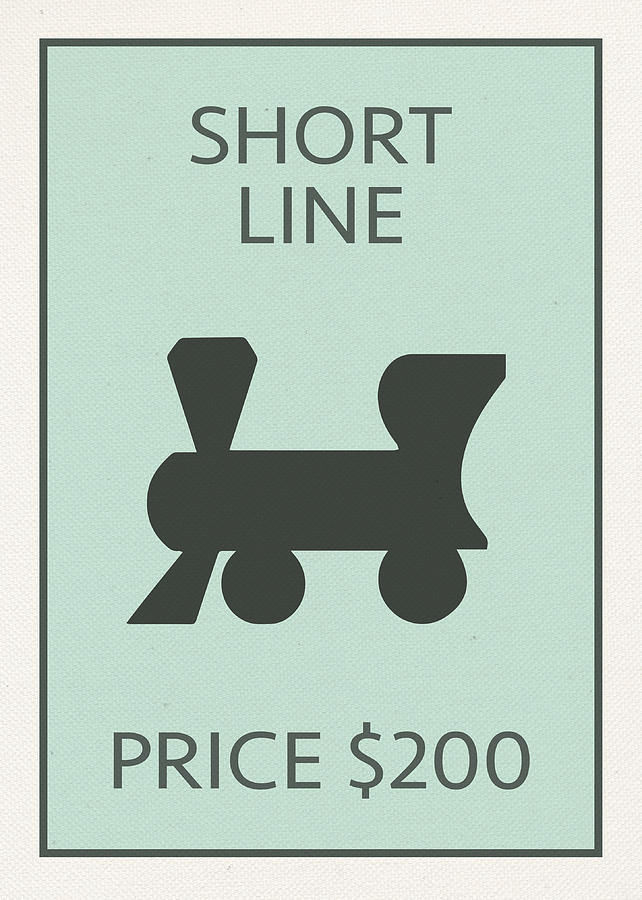
The Mystery of Short Line
Now we arrive at Monopoly's most mysterious railroad.
Unlike the B&O, Reading, and Pennsylvania, the game's creator never clearly identified what Short Line represented.
Many people assume it was simply a generic railroad name. However, in railroading, a short line is a very specific thing.
A short line railroad is typically a smaller railroad operating over a limited distance. Rather than spanning entire regions, these railroads often connect local communities with larger rail networks.
Think of them as the bridges between major railroads and smaller towns. They provide service where larger railroads may not find it economical to operate.
Today, short lines play an important role in moving freight across North America.
Was Monopoly's Short Line Actually the Shore Fast Line?
Many game historians believe Monopoly's Short Line may have been inspired by a railroad called the Shore Fast Line.
The Shore Fast Line was an electric interurban trolley route that operated along the New Jersey coast, connecting Atlantic City and Ocean City.

Operated by the Atlantic City and Shore Railroad, it carried residents and vacationers along the Jersey Shore during the early twentieth century.
The line eventually succumbed to changing transportation habits, declining trolley traffic, and hurricane damage. It closed in 1948.
If this theory is correct, millions of Monopoly players have spent generations landing on a space that quietly commemorates a long-vanished trolley line.
Short Lines Are Still Around
While many historic railroads disappeared through mergers and bankruptcies, short lines continue to thrive.
Today there are hundreds of short line railroads operating across North America. These railroads connect farms, industries, and rural communities to larger freight networks, often using tracks abandoned by larger carriers.
They may be smaller than the railroad giants, but they remain essential parts of the transportation system.
And among those surviving railroads is one of the most famous of all.
Strasburg: The Little Railroad That Never Stopped Running
The Strasburg Rail Road was chartered in 1832 to connect the town of Strasburg with the growing rail network of Lancaster County, Pennsylvania.
At a time when goods typically moved by wagon, the railroad provided farmers and businesses with faster access to larger markets.
For generations, Strasburg carried passengers, mail, freight, and agricultural products. It became an important part of daily life in the region.
By the 1950s, however, the railroad faced a challenge shared by many railroads across America. Increasing competition from trucks, automobiles, and airplanes pushed the line toward abandonment.
Fortunately, local supporters stepped in.
Instead of allowing the railroad to disappear, they purchased the line and transformed it into a steam-powered tourist railroad.
Today, visitors can still ride behind historic steam locomotives while the railroad's restoration shops rebuild and maintain locomotives and railroad equipment from across the country.
Nearly two centuries after its charter was granted, the Strasburg Rail Road continues to operate.
That's why it deserves a title few railroads can claim:
The little railroad that never stopped running.
Final Whistle
The next time you play Monopoly and land on Short Line, take a closer look at the railroad spaces.
Three represent some of the most influential railroads in American history. The fourth may be a tribute to a forgotten New Jersey trolley line, or perhaps to the thousands of small railroads that connected America together.
Either way, the story reminds us that railroad history isn't just found in museums or old photographs.
Sometimes it's hiding in plain sight on a board game that's been sitting on the shelf all along.
We made a video on this! Go to: https://youtu.be/lPvdYosIKcU
If you're ever near Lancaster County, Pennsylvania, consider visiting the Strasburg Rail Road to see a piece of living railroad history still in motion today.
© 2026, www.whistlewisp.com
Comments